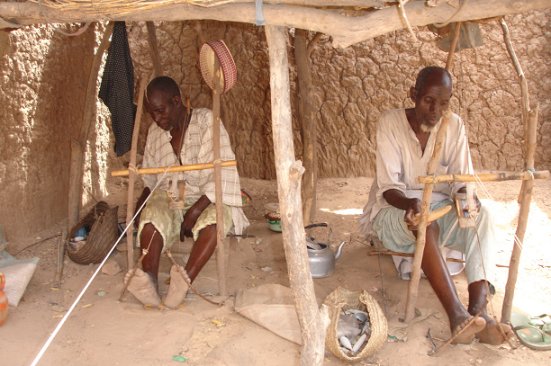
Lets look at some textures. Finding out what things are made of will then help me with creating props and learning how to incorporate these things into my designs. It'll also give me an insight into the history of Africa that isnt just fashion based.
TEXTILES
The earliest surviving sub-Saharan African textiles are cloth fragments and parchment fragments that date to the ninth century BC from sites at Igbo Ukwu of the Igbo people of Nigeria. Some twelfth century cloth fragments date from the Tellem caves in Mali. Surviving thirteenth century samples originate from Benin City in Nigeria.
African textiles are a part of African cultural heritage that came to America along with the slave trade. As many slaves were skilled in the weaving, this skill was used as another form of income for the slave owner.
African Men and Women Weaving
In most of Africa the weavers were men while the women spun the thread. The weavers in many of the countries were part of a caste-like group and sometimes slaves to noble families. In Yoruba compounds were used where master weavers would teach all the boys weaving and all the girls would learn to spin and dye the yarn. And children did some jobs too, like providing fabric and also weaved at a very young age of 4.
Some examples of African textiles are:
Aso oke fabric - woven by Yoruba people
Adire- tie-dye produced by Yoruba people
Kente cloth - woven by Ashanti and Ewe people
Barkcloth - produced by the Buganda tribe
Mudcloth- produced by the Bambara tribe
Kitenge - produced in Kenya and other regions of East Africa
Yoruba Nigeria Cotton Fabric
Yoruba African Tie Dye Fabric - West African Land and Sea Colours
Kente Cloth being Hand-Woven
Kente Cloth Pattern, Ghana, woven by Ashanti and Ewe People
Buganda Tribe beating Bark Cloth
Bark Cloth - Buganda Tribe of Uganda
Cotton Mudcloth - Bambra Tribe of Mali
Kitenge - Produced in Kenya and Other Regions of East Africa
These images are each of some tribal fabrics. There is a brief description of how they are made in the captions, but lets just say they are all made from earthy products and all made by hand. They are each woven, using tiny machines and handwork. Some cloths are made from the cotton in which the people grow, others are made from mud or clay. These fabrics are then worn by the people of the tribes. Although the textiles are made with such poor conditions and quality control, they are still made exciting and happy with the use of colour and patterns. Its completely mind blowing that people are able to do this with so little help of machinary. The textiles (in my opinion) should be worn with such pride, and whenever I see something like this again I will feel that!
African tribal fashion to me is beads, colour, fur, feathers and boldness. However, its not just the tribal styling that creates this look, it is also accomplised in the general fashion world. Many other trends adopt beads and patterns, which is something I now want to start looking at. I have collected together a few images that are inspired by each of these things and that are not necesserily tribal.
I am looking at items of clothing, shoes, jewellery and other accessories that have adopted a tribal theme, but wouldnt necesserily be what I would use for a shoot to suggest tribal. Instead, they are influences for me and give me an idea on the texture, colour and patterns used. The fashion is obviously inspired by tribe, but has been adapted to fit into the fashion world. I think this is important to consider because it gives me an insight on how to make my editoiral and catwalk designs contemporary to fit with todays fashion world.
Contemporary Fashion Sandals Inspired by Tribal
Original African Tribal Shoes
Contemporary African Jewellery
Original African Beads
Contemporary African Tribal Fashion
Original Zulu Fashion
Contemporary African Art
Traditional African Art
Contemporary African Pattern
Traditional African Pattern
Although this is a brief post, I just wanted to show an example of how trends have been changed from the original styles to the contemporary styles. Like I say this allows me to see how to make editorial and catwalk images work. Looking at the comparisons of the images, I think now you'll also be able to see the similarities, but the differences. This is really giving me a good idea on what I need to be working towards and how I can develop my ideas into brilliant designs.
Its time to look at fashions outside of the tribal world. These fashions are more current, but would have the same effect on creativity as tribal does. For example: Punks have a very particular style that make them unique, but also show which 'tribe' they belong to (so to speak).
I am going to look at punk because it is quite an obvious example. Their look is very to themselves and you would never not know what style they would be linked with. However, its not just the clothing - its also the hair, the makeup, the piercing and the accessories. Take a look!
PUNK
Punk Rock Facial Art
Punk Fashion
Punk Editoral Fashion
Drastic, Colourful Punk Hair
Punk Piecerings and Tattoo's
Vivienne Westwood Punk inspired catwalk. She was BIG on punk.
These images just give a brief overview of what a tribe could also be. It takes me away from just looking at tribes from the past and takes me more into the contemporary world. It allows me to explore a fashion trend that is synominous with punks. (associated as them).
There are some things that I have seen in the Punk trend that has made me think of African styling. For example, they wear a lot of jewellery which is something Zulu's are well known for. The big hair also reminds me of the baskets that African women wear on their heads. This is a look that I want to create for my catwalk look, and to see the big hair makes me inspired by this. There are such similarities in punk fashion and my african fashion, hense why I have chosen punk as my 'Out of Africa' style!
Its come to my attention that nail art is extremely popular witt todays fashion trends. This is something I wanted to look to ensure that I can incorporate nails with my editorial and catwalk looks - just to make sure they are completely approriate for todays trends!
I have started to look at tribal nails in order to get a feel of what they are like. I have noticed that the aztec tribal patterns seem the most popular for tribal inspiration, using bold colours and lots of black outlining. First of all, I have found this video on youtube that tells you how to create a tribal pattern. So take a look - its simple, but cool!
Now take a look at some of the images I have been inspired by:
Earthy African Tribal
Aztec Nails
Colourful Aboriginal Inspired Nails
Tribal with Animal Print
Tribal Colour Nails Accompanied with Accessories
Each of these nails represent tribal. Some are colourful, focusing more on Aztec and Aboriginal patterns, and others are more African combined with the signature earthy colours. Although this could be too much to add within my looks, I found it necessary to research the patterns. The final image I have shown is there because it really suggests how well the nails would work with the accessories. Its also very african inspired.. we all know I love this!!
Well... I have come to the conclusion that maybe I have looked at images that are a little too focus on editoral and not so focused on catwalk. So, its now time to talk about catwalk! I have looked at some designers in the past posts that have gone from tribal to catwalk, but I want to look a little more indept and explore some more.
John Galliano went tribal at his Paris Fashion Week show for Christian Dior
yesterday, with an African-inspired collection full of cowrie-shell
studded bustiers, sculptural head-dresses and stilettos shaped like
fertility goddesses. Short and sexy was also a recurring theme, with
mid-thigh minis and see-through dresses. The most obvious reference to the show's title was in the hair styling -
the models' hair was crimped and pulled back into chignons that were
shaped like the mini tribal drums usually found on hippy stalls. A
raspberry silk and suede dress was heavily embroidered with shells and
decorated with fringing. Amazing!
Here are images from the catwalk:
I absolutely adore the concept of these catwalk images. Full of dark secrets and wonderful ideas! The hair is amazing and as mentioed before the main focus of each of the styles. I think it looks incredible! One of my favourite images is the first one because it is so styled and full of jewellery and that is something I am hugely attracted to with this tribal project. I also love the fourth image, because the large feather head piece is so brave. It draws a lot of attention away from the face, but from parts of the face you can see, the styling echos so well and the combination of the outfit is fabulous!
Give this video a watch to see the Missoni Spring 2011 'tribal' catwalk. Its amazing. Its all about tribalism but making it much more sophisticated. Its full of vibrant and earthy colours and african influence. A lot of the designs appear like rugs that have been made into a feminine outfit. Its almost portraying the life of a tribal person, from taking something simple and making it beautiful. Something to represent them as a tribe and as a person.
Missoni is a lot different from Galliano's in so many different ways. Instead of representing a specific tribe, it shows the fashion of tribal in general. It focuses a lot on the idea of the patterns, possibly edging it more towards the idea of it being aztec. The look is a lot more focused on makeup and styling as well. Its simply beautiful - a constant flow of earthy colours! Everything works so well together and the representation of tribal shows though so obviously. The makeup was done by MAC makeup artist Amber D - she was adiment the dark lips would be the statement focal point and she was 100% right, it works SO well! Its so wintery - such a difference from what you would think tribal would be.
McQueen's catwalk trends are usual very urban based. But, for this catwalk trend, McQueen decided to do different and go tribal. Inspired by the Yoruba people of West Africa, McQueen's 'Eshu' catwalk told a beautiful story.
Oringally, the collection was to be shown in London. But, very bravely, McQueen decided he was to show it in Paris instead. Not only was it just inspired by the Yoruba people themselves, it was also strongly inspired by their mythology. In africa, the clothing was once made of furs, animal prints, skins adn feathers. McQueen used this within his collection creatingbodily decorations which consisted of heavy steel and wooden bangles,
pierced septa and lips, pubic aprons, and traditional Yoruba tattoo
scarring called Kolo. All of these ideas represented the body modification aesthetic
of the Yoruba belief that scarification is pure and natural.
Powder glass beads the color of the concrete rendering cascaded
mud-spattered, transparent tunic dresses while the trickster Eshu deity
was depicted in the form of carved horsehair headpieces. The hair looks muddy and clay like and was stiftened into position, looking like wire and hair. Jewellery was made originally from elephants hair, but in this case inspired by wire.
I absolutely love this collection, its so creative and tells such a good story of a tribe. Some people think tribal references in fashion are bad because they interfere with a tribe and ruin them, but I persoanlly think that they are a good idea because they allow people to know about them and be inspired by them.
Check out this website to read up more about the collection:
I'll go over the annotations on the photo because its a little unreadable!
Basically,
this look all about the hair! Inspired by the Zulu African woman, I
wanted to make the hair look like the bowls that women carry on their
head. This is to be done with the hair, but mostly making a model out of
something and using a lot of crepe hair. Again, I have gone for a lot
of accessories and beads! and then to top off with the MAori look I kept
it so subtle and did a dotted line between the make up and the hair,
almost to suggest the divide between them both (and, I suppose both
tribes as well!). I then went for the fur around the neck, but I
honestly think that was a little too much!
This is my first face chart idea.
As you can see, I have gone very much between the look of the African Tribe
(Zulu) an combined it slightly with the idea of Maori boy tattoos. I have kept
the face very clean from tattoos in order to produce a smooth editorial look. I
don't like the make up to look too messy and over crowded. I love the idea of
showing off a tribal look with accessories, so I have gone big on the beads -
around the neck, ears and head. I would also be doing the same as the
accessories and body part sketch I have shown above. For the face, I have stuck
to quite earthy colours because I want the accessories to take centre stage. It
is really important that they both echo each other beautifully and in this case
I think they do really well.